A Childhood Classic Reimagined: Mabel Lucie Attwell’s The Water Babies
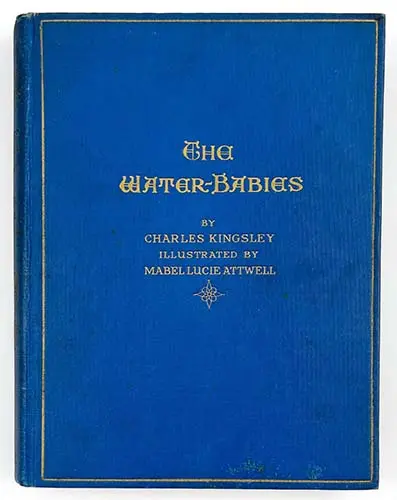
There are certain illustrated books that seem to have been loved into existence—volumes so warmly familiar, so infused with charm, that they feel less like objects and more like old friends. Mabel Lucie Attwell’s edition of Charles Kingsley’s The Water Babies is one such book. First published in 1915, this beloved version transformed a Victorian moral fable into a cozy, accessible treasure for generations of young readers, all through the singular genius of one of Britain’s most adored illustrators.
By the time she took on The Water Babies, Mabel Lucie Attwell was already a household name. Born in London’s East End in 1879, she had studied at the Regent Street School of Art and the Heatherley School of Fine Art, yet her true education came from her instinctive understanding of childhood. Her style—characterized by round-faced, rosy-cheeked toddlers with button noses, mischievous expressions, and an irresistible air of innocence—struck a chord with the public that never wavered throughout her long career. Attwell did not merely illustrate children; she seemed to inhabit their world, capturing their joys, their sorrows, and their boundless capacity for wonder with an authenticity that few artists have ever achieved.
Charles Kingsley’s original The Water Babies, published in 1863, is a complex work—a moral allegory that follows the young chimney sweep Tom as he drowns and is reborn as an aquatic creature, embarking on a journey of redemption and self-discovery. It is a story rich with Victorian social commentary, religious symbolism, and satirical jabs at the scientific debates of the era. For a young child, however, these layers could prove daunting. This is where Attwell’s genius came into play. She did not alter Kingsley’s text, but her illustrations reframed it entirely, emphasizing the story’s warmth, its humor, and its sense of adventure while softening its more didactic edges.
Attwell’s Tom is the quintessential Attwell child—cherubic, plump, and utterly endearing, even in his sooty chimney-sweep guise. His eyes are wide with curiosity, his expression a blend of mischief and vulnerability that invites instant sympathy. The underwater world she creates is not a place of moral trial but a magical realm of smiling fish, friendly crabs, and floating flowers, rendered in her characteristically soft lines and gentle palette of blues, greens, and warm pinks. Her fairies, particularly the stern yet kindly Mrs. Doasyouwouldbedoneby, possess the same round-faced charm as her children, transforming potential sternness into something approachable and loving.
The book was published by Hodder & Stoughton, a firm renowned for its lavishly illustrated gift books during the Golden Age of Illustration. While Attwell’s work differed markedly from the ethereal, Art Nouveau-influenced styles of contemporaries like Arthur Rackham or Edmund Dulac, her appeal was arguably broader and more enduring. Her Water Babies was not a luxury object for collectors alone; it was a book meant to be held, read aloud, and cherished by children themselves. The volume featured twelve full-color plates, each mounted and protected by tissue guards, alongside numerous black-and-white line drawings that danced throughout the text, ensuring that Attwell’s vision was present on nearly every page.
What makes Attwell’s The Water Babies so enduring is its spirit of kindness. In her hands, Kingsley’s story becomes less a cautionary tale and more a celebration of childhood resilience, of second chances, and of the simple truth that even the smallest among us are capable of great transformation. Her illustrations wrap the reader in a sense of safety and warmth, as if the book itself were a hug.
Today, Mabel Lucie Attwell’s The Water Babies remains a beloved classic, its images etched into the collective memory of countless readers who first encountered Tom’s adventures through her eyes. It stands as a testament to the power of illustration to reshape and humanize a story, and to the enduring magic of an artist who never forgot what it felt like to be small.
For admirers of this edition, these kindred works may charm:
• Peter Pan and Wendy (1921) illustrated by Attwell – her other major fantasy adaptation
• The Water Babies (1915) illustrated by Jessie Willcox Smith – a contrasting pre-war interpretation
• Alice’s Adventures in Wonderland (1910) by Attwell – showcasing her best adaptation of Lewis Carroll‘s classic
Art Gallery: Mabel Lucie Attwell – The Water Babies 1915