A Cozy Wonderland: Mabel Lucie Attwell’s Alice in Wonderland
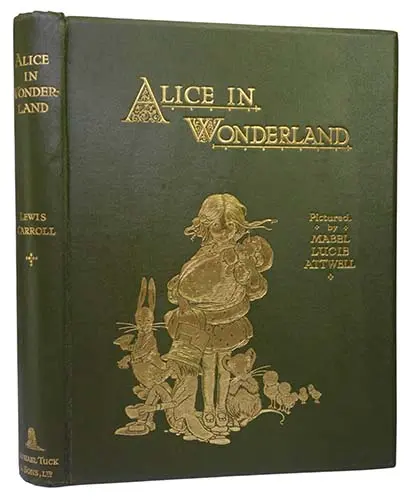
In the crowded field of Alice illustrators, Mabel Lucie Attwell occupies a special place. Where John Tenniel emphasized the strange, where Arthur Rackham emphasized the ethereal, Attwell emphasized the familiar. Her 1910 edition of Lewis Carroll’s Alice in Wonderland transformed the surreal adventures of the little girl from Oxford into a cozy, accessible world—a Wonderland that felt less like a dream and more like a place any child might visit after tea.
Mabel Lucie Attwell (1879–1964) was one of the most beloved illustrators of her generation. Her style—characterized by round-faced, rosy-cheeked toddlers with button noses and mischievous expressions—had become a staple of Edwardian nurseries. She had illustrated Mother Goose, Peter Pan, and the Grimm’s Fairy Tales, each time bringing her signature warmth to the stories. When she turned her attention to Alice, she approached it with the same sensibility: as a tale to be read aloud, to be held in small hands, to be cherished.
The 1910 edition, published by Hodder & Stoughton in London, was a handsome production. The volume contained twelve full-page color plates alongside numerous black-and-white illustrations woven throughout the text. The binding was in cloth with a gilt design on the front cover—an illustration of Alice, rendered in Attwell’s unmistakable style, that invited young readers into her world.
What distinguishes Attwell’s Alice is her approachability. Her Alice is not the sharp, inquisitive child of Tenniel’s illustrations nor the ethereal figure of Rackham’s interpretation. She is, instead, a quintessential Attwell child: round-cheeked, wide-eyed, with golden hair and an expression of gentle curiosity. She looks less like a Victorian heroine and more like the child next door—familiar, approachable, and utterly endearing.
Attwell’s approach to the inhabitants of Wonderland was similarly softening. The Cheshire Cat’s famous grin remains, but the creature behind it is rendered with rounded edges and a twinkle in its eye. The Mad Hatter’s tea party becomes a scene of cozy eccentricity rather than surreal disorientation. The Queen of Hearts, while still commanding, possesses a certain plump grandmotherliness that diminishes her menace. Even the mock turtle and the gryphon, in Attwell’s hands, seem more wistful than grotesque.
The color plates are warm and inviting. Attwell’s palette favored soft pinks, gentle blues, warm yellows, and touches of earthy green—colors that evoke the comfort of a well-loved nursery rather than the strangeness of a dream. Her compositions are carefully balanced, with a keen attention to the expressive possibilities of her characters’ faces. Alice’s bewilderment, the Hatter’s eccentricity, the Queen’s imperiousness—all are rendered with a clarity that makes them accessible to the youngest readers.
The critical reception of Attwell’s Alice was positive, and the book found its audience in families seeking a less intimidating introduction to Carroll’s classic. It remained in print for decades, reprinted in various formats, and has become a cherished collectible for those who grew up with Attwell’s gentle Wonderland.
Today, first editions of Attwell’s Alice are prized by collectors. The fragile binding makes surviving copies in fine condition increasingly scarce. For those fortunate enough to own one, the book offers a glimpse of a Wonderland that feels less like a descent into the strange and more like a ramble through the imagination—a place where any child would feel at home.
In the pages of this book, Alice still follows the White Rabbit, still grows and shrinks, still sits at the Mad Hatter’s tea party. But she does so with the warmth and familiarity that Mabel Lucie Attwell brought to everything she illustrated. It is a Wonderland for the nursery, a Wonderland for small hands, a Wonderland where every child, upon closing the book, knows that adventure awaits—just around the corner, or perhaps just through the looking glass.
Recommended for collectors and readers:
- Peter Pan and Wendy (1921), illustrated by Mabel Lucie Attwell – A whimsical and touching interpretation of Barrie’s fantasy tale.
- Grimm’s Fairy Tales (1912), illustrated by Mabel Lucie Attwell – A softened version of the Brothers Grimm’s classic stories, ideal for young readers.
- Mother Goose’s Nursery Rhymes (1910), illustrated by Mabel Lucie Attwell – A delightful introduction to classic rhymes with playful illustrations.
Presenting one of Mabel Lucie Attwell’s most celebrated work and one of the most loved book Alice’s Adventure in Wonderland. First published by Raphael Tuck in 1910.
Attwell’s other illustrated books available in our gallery include: Grimm Fairy Tales, The Water Babies and Peter Pan & Wendy.
Art Gallery: Mabel Lucie Attwell – Alice in Wonderland 1910