A Treasury of Tradition: Rackham’s English Fairy Tales
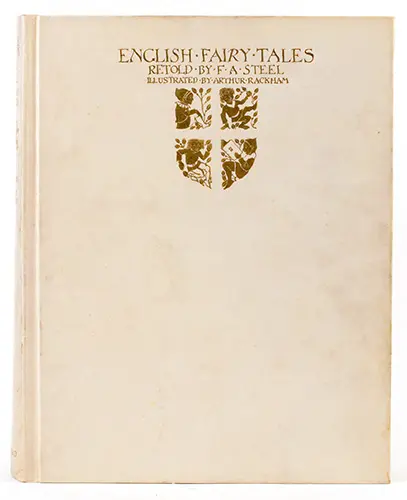
Arthur Rackham’s illustrated edition of English Fairy Tales stands as one of the most significant and enduring works in the artist’s celebrated career, representing a masterful union of folkloric tradition and artistic imagination. Published in 1918 by William Heinemann in London and David McKay in Philadelphia, this volume appeared during the final months of the First World War, offering readers a timely retreat into the rich heritage of English folklore.
The book presents a carefully curated selection of traditional tales retold by Flora Annie Steel, a writer and folklorist who had previously collaborated with Rackham on Tales of the Round Table and The Red Fairy Book. Steel’s retellings draw upon the rich tapestry of English folklore, presenting beloved stories that had been passed down through generations of oral tradition. Among the tales included are such enduring favorites as “Jack and the Beanstalk,” “The Three Little Pigs,” “Tom Thumb,” “Dick Whittington,” “The Golden Goose,” and “The Story of the Three Bears.” Each narrative is rendered with a storyteller’s ear for rhythm and a scholar’s respect for the traditional sources, capturing the earthy humor, moral complexity, and occasional darkness that characterize genuine folklore.
Rackham’s contribution to the volume comprises sixteen tipped-in color plates, each mounted on heavy paper and protected by a captioned tissue guard, alongside numerous pen-and-ink drawings dispersed throughout the text. The illustrations represent the artist’s mature style at its most assured, demonstrating his extraordinary ability to capture both the whimsical and the uncanny elements of traditional fairy tales. The color plates are rendered in Rackham’s characteristic palette of soft greens, warm ambers, deep browns, and subtle golds, creating an atmosphere of timeless enchantment that perfectly complements Steel’s retellings.
The frontispiece, depicting Jack confronting the giant at the summit of the beanstalk, ranks among Rackham’s most memorable images. The composition captures the moment of peril with remarkable dramatic tension—Jack’s diminutive figure silhouetted against the monstrous form of the giant, the beanstalk stretching endlessly into a misty sky. Other plates reveal the full range of Rackham’s interpretive gifts. The illustration for “The Three Little Pigs” presents the wolf in a moment of comic frustration, while “Dick Whittington” captures the magical atmosphere of the London streets with its bells ringing across the city. “Tom Thumb” showcases Rackham’s gift for rendering miniature figures within expansive landscapes, the tiny hero rendered with as much care and character as any full-sized protagonist.
The pen-and-ink drawings scattered throughout demonstrate Rackham’s extraordinary facility with line. These smaller illustrations range from delicate vignettes to more substantial compositions, each capturing some detail of the tales—a fairy emerging from a flower, a clever fox outwitting its pursuers, a humble cottager receiving unexpected visitors—with economy and grace. The drawings serve to extend the visual experience of the book, creating a seamless integration of image and text.
The first edition reflects the high production values associated with Heinemann’s deluxe illustrated volumes. The trade edition was bound in green cloth with gilt stamping to the spine and front cover, while the limited edition—numbering just 525 copies signed by Rackham—was issued on larger handmade paper with the plates mounted on art paper and bound in white boards with vellum spines. Some copies were subsequently bound in full morocco by fine binders, representing the highest expressions of the bookbinder’s art.
English Fairy Tales holds a special place in Rackham’s bibliography as a work that captures the artist at the height of his powers, bringing his singular vision to the folkloric heritage of his native land. Together, Steel’s retellings and Rackham’s images create a treasury of English tradition that continues to enchant readers more than a century after its first appearance.
Recommended for collectors:
- Grimm’s Fairy Tales (1909), illustrated by Arthur Rackham – A perfect companion with similarly iconic imagery and darkly magical themes.
- The Red Fairy Book (1890) by Andrew Lang, illustrated by H. J. Ford – A foundational anthology in fairy tale collections, filled with global lore.
- Old French Fairy Tales (1920), illustrated by Virginia Frances Sterrett – Delicate, dreamlike illustrations paired with timeless French fables.
Art Gallery: Arthur Rackham – English Fairy Tales
![Arthur Rackham - English Fairy Tales [rackham-english01] (art, illustrations)](https://www.nocloo.com/wp-content/plugins/justified-image-grid/timthumb.php?src=https%3A%2F%2Fwww.nocloo.com%2Fart%2Frackham-english%2Frackham-english01.jpg&h=280&q=90&f=.jpg "Arthur Rackham - Illustrations for English Fairy Tales 1918")
![Arthur Rackham - English Fairy Tales [rackham-english02] (art, illustrations)](https://www.nocloo.com/wp-content/plugins/justified-image-grid/timthumb.php?src=https%3A%2F%2Fwww.nocloo.com%2Fart%2Frackham-english%2Frackham-english02.jpg&h=280&q=90&f=.jpg "Arthur Rackham - Illustrations for English Fairy Tales 1918")
![Arthur Rackham - English Fairy Tales [rackham-english03] (art, illustrations)](https://www.nocloo.com/wp-content/plugins/justified-image-grid/timthumb.php?src=https%3A%2F%2Fwww.nocloo.com%2Fart%2Frackham-english%2Frackham-english03.jpg&h=280&q=90&f=.jpg "Arthur Rackham - Illustrations for English Fairy Tales 1918")
![Arthur Rackham - English Fairy Tales [rackham-english04] (art, illustrations)](https://www.nocloo.com/wp-content/plugins/justified-image-grid/timthumb.php?src=https%3A%2F%2Fwww.nocloo.com%2Fart%2Frackham-english%2Frackham-english04.jpg&h=280&q=90&f=.jpg "Arthur Rackham - Illustrations for English Fairy Tales 1918")
![Arthur Rackham - English Fairy Tales [rackham-english05] (art, illustrations)](https://www.nocloo.com/wp-content/plugins/justified-image-grid/timthumb.php?src=https%3A%2F%2Fwww.nocloo.com%2Fart%2Frackham-english%2Frackham-english05.jpg&h=280&q=90&f=.jpg "Arthur Rackham - Illustrations for English Fairy Tales 1918")
![Arthur Rackham - English Fairy Tales [rackham-english06] (art, illustrations)](https://www.nocloo.com/wp-content/plugins/justified-image-grid/timthumb.php?src=https%3A%2F%2Fwww.nocloo.com%2Fart%2Frackham-english%2Frackham-english06.jpg&h=280&q=90&f=.jpg "Arthur Rackham - Illustrations for English Fairy Tales 1918")
![Arthur Rackham - English Fairy Tales [rackham-english07] (art, illustrations)](https://www.nocloo.com/wp-content/plugins/justified-image-grid/timthumb.php?src=https%3A%2F%2Fwww.nocloo.com%2Fart%2Frackham-english%2Frackham-english07.jpg&h=280&q=90&f=.jpg "Arthur Rackham - Illustrations for English Fairy Tales 1918")
![Arthur Rackham - English Fairy Tales [rackham-english08] (art, illustrations)](https://www.nocloo.com/wp-content/plugins/justified-image-grid/timthumb.php?src=https%3A%2F%2Fwww.nocloo.com%2Fart%2Frackham-english%2Frackham-english08.jpg&h=280&q=90&f=.jpg "Arthur Rackham - Illustrations for English Fairy Tales 1918")
![Arthur Rackham - English Fairy Tales [rackham-english09] (art, illustrations)](https://www.nocloo.com/wp-content/plugins/justified-image-grid/timthumb.php?src=https%3A%2F%2Fwww.nocloo.com%2Fart%2Frackham-english%2Frackham-english09.jpg&h=280&q=90&f=.jpg "Arthur Rackham - Illustrations for English Fairy Tales 1918")
![Arthur Rackham - English Fairy Tales [rackham-english10] (art, illustrations)](https://www.nocloo.com/wp-content/plugins/justified-image-grid/timthumb.php?src=https%3A%2F%2Fwww.nocloo.com%2Fart%2Frackham-english%2Frackham-english10.jpg&h=280&q=90&f=.jpg "Arthur Rackham - Illustrations for English Fairy Tales 1918")
![Arthur Rackham - English Fairy Tales [rackham-english11] (art, illustrations)](https://www.nocloo.com/wp-content/plugins/justified-image-grid/timthumb.php?src=https%3A%2F%2Fwww.nocloo.com%2Fart%2Frackham-english%2Frackham-english11.jpg&h=280&q=90&f=.jpg "Arthur Rackham - Illustrations for English Fairy Tales 1918")
![Arthur Rackham - English Fairy Tales [rackham-english12] (art, illustrations)](https://www.nocloo.com/wp-content/plugins/justified-image-grid/timthumb.php?src=https%3A%2F%2Fwww.nocloo.com%2Fart%2Frackham-english%2Frackham-english12.jpg&h=280&q=90&f=.jpg "Arthur Rackham - Illustrations for English Fairy Tales 1918")
![Arthur Rackham - English Fairy Tales [rackham-english13] (art, illustrations)](https://www.nocloo.com/wp-content/plugins/justified-image-grid/timthumb.php?src=https%3A%2F%2Fwww.nocloo.com%2Fart%2Frackham-english%2Frackham-english13.jpg&h=280&q=90&f=.jpg "Arthur Rackham - Illustrations for English Fairy Tales 1918")
![Arthur Rackham - English Fairy Tales [rackham-english14] (art, illustrations)](https://www.nocloo.com/wp-content/plugins/justified-image-grid/timthumb.php?src=https%3A%2F%2Fwww.nocloo.com%2Fart%2Frackham-english%2Frackham-english14.jpg&h=280&q=90&f=.jpg "Arthur Rackham - Illustrations for English Fairy Tales 1918")
![Arthur Rackham - English Fairy Tales [rackham-english15] (art, illustrations)](https://www.nocloo.com/wp-content/plugins/justified-image-grid/timthumb.php?src=https%3A%2F%2Fwww.nocloo.com%2Fart%2Frackham-english%2Frackham-english15.jpg&h=280&q=90&f=.jpg "Arthur Rackham - Illustrations for English Fairy Tales 1918")
![Arthur Rackham - English Fairy Tales [rackham-english16] (art, illustrations)](https://www.nocloo.com/wp-content/plugins/justified-image-grid/timthumb.php?src=https%3A%2F%2Fwww.nocloo.com%2Fart%2Frackham-english%2Frackham-english16.jpg&h=280&q=90&f=.jpg "Arthur Rackham - Illustrations for English Fairy Tales 1918")