An Enchanted Isle: Edmund Dulac’s The Tempest
In the rich history of Shakespeare illustration, certain editions stand as landmarks—interpretations so vivid and distinctive that they reshape how generations imagine the plays. Edmund Dulac’s 1908 edition of The Tempest is such a work. Published by Hodder & Stoughton in London, this volume represents the artist’s first foray into Shakespeare illustration, and it remains one of the most beautiful interpretations of the Bard’s enchanted final play ever produced.
Edmund Dulac (1882–1953) was at the height of his early fame when he undertook the Shakespeare commission. His Arabian Nights (1907) had established him as a major force in the Golden Age of Illustration, and his Rubáiyát was soon to follow. The Tempest offered him a subject perfectly suited to his talents: an island of magic, a spirit of the air, a monster of the earth, and a story of forgiveness and reconciliation set against a backdrop of supernatural beauty.
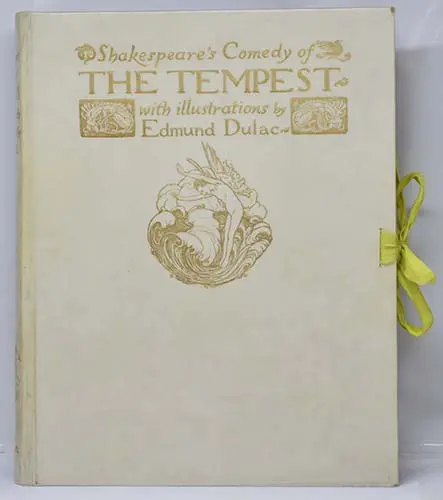
The 1908 edition was a lavish production, issued in both trade and limited editions. The binding was in white vellum with gilt stamping—a pristine canvas that reflected the ethereal quality of the illustrations within. Inside, readers discovered fourty full-page color plates, each mounted on heavy paper and protected by captioned tissue guards, alongside decorative elements woven throughout the text. The plates were among the most extensive Dulac produced for any volume, and they represent some of the most extraordinary work of his career.
What distinguishes Dulac’s The Tempest is his ability to capture the dual nature of the play—its blend of comedy and romance, of earthly reality and ethereal magic. His Prospero is a figure of dignity and authority, his robes flowing, his staff raised, his gaze fixed on the horizon. His Miranda is a vision of youthful innocence, her face reflecting wonder at the shipwreck and the strange new world unfolding before her. His Ariel, the spirit of the air, is rendered with an ethereal grace that captures the character’s otherworldly nature—a presence of light and air, suspended between the visible and the invisible.
The island itself is a character in Dulac’s illustrations—a place of rocky cliffs and hidden caves, of ancient trees and luminous skies. His palette captures the play’s range: the storm-tossed seas of the opening are rendered in deep blues and turbulent whites; the island interiors glow with warm golds and soft greens; the masque of Ceres bursts with the colors of harvest and abundance. The influence of Persian miniatures is evident in the flattened perspectives and intricate patterning; the influence of Art Nouveau is visible in the sinuous lines and decorative borders.
Dulac’s Caliban is a remarkable achievement—a creature of earth and appetite, yet rendered with a complexity that acknowledges the character’s tragic dimension. His hunched form, his gnarled features, his brutish posture are balanced by a suggestion of the poetry in his speech, the longing in his heart. It is a Caliban who evokes both disgust and pity—a visual interpretation that matches Shakespeare’s ambiguous creation.
The critical response to Dulac’s The Tempest was enthusiastic. Reviewers praised his ability to capture “the magic of the island” and his “extraordinary range” as an artist. The volume sold well and established Dulac as a worthy interpreter of Shakespeare, paving the way for his later illustrations for The Tempest and other plays.
Today, first editions of Dulac’s The Tempest are highly prized by collectors. For admirers of Dulac’s art, the volume represents a high point in his career, a work where his decorative elegance met the poetic depth of Shakespeare, and the result was a masterpiece of the illustrated book.
In its pages, the storm still rages, the island still enchants, Ariel still sings, and Prospero still renounces his magic. Edmund Dulac gave Shakespeare’s final play a visual language of extraordinary beauty—a reminder that the greatest illustrated books are those that, like the play itself, transport us to an enchanted isle where the boundaries between the real and the imagined dissolve, and where, for a moment, we believe in magic.
Recommended for Collectors and Fans:
- Stories from The Arabian Nights (1907), illustrated by Edmund Dulac – A stunning collection of tales with rich Orientalist illustrations that made Dulac famous.
- The Rubáiyát of Omar Khayyám (1909), illustrated by Edmund Dulac – A lyrical, mystical Persian classic rendered in some of Dulac’s most intricate and atmospheric work.
- Comus by John Milton (1921), illustrated by Arthur Rackham – A poetic masque filled with myth and magic, brought to life with Rackham’s darker, fantastical style.
These editions offer a blend of literary richness and visual enchantment, ideal for fans of the Golden Age of illustrations.
Other books illustrated by Edmund Dulac available in our gallery: Stories from the Arabian Nights, Lyrics, Pathetic and Humourous from A to Z, The Rubaiyat of Omar Khayyam, The Sleeping Beauty, Stories from Hans Andersen, The Bells, and other poems, Princess Badoura, Sindbad the Sailor and other stories, The Kingdom of the Pearl.
- Complete list of books illustrated by Edmund Dulac.
- Our Edmund Dulac Art Gallery
Art Gallery: Edmund Dulac – The Tempest 1908