A Vision of Paradise: Edmund Dulac’s Rubáiyát of Omar Khayyám
Limited Edition
In the pantheon of illustrated books produced during the Golden Age, few volumes achieved the perfect synthesis of text, image, and design achieved by Edmund Dulac’s 1909 edition of the Rubáiyát of Omar Khayyám. Published by Hodder & Stoughton in London, this work marked a turning point in Dulac’s career—a shift from the illustrative to the interpretive, from the decorative to the deeply evocative. It remains, for many admirers, the pinnacle of his achievement.
The Rubáiyát had already been transformed into an English classic by Edward FitzGerald, whose 1859 translation captured the hedonistic wisdom of the eleventh-century Persian poet with a lyrical beauty that transcended its origins. The quatrains—meditations on love, wine, mortality, and the fleeting nature of pleasure—had become a touchstone of Victorian and Edwardian culture, and the demand for illustrated editions was intense. Dulac’s interpretation would become one of the most celebrated.
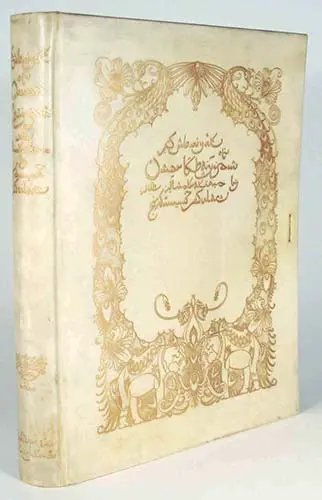
The 1909 edition was a lavish production, issued in both trade and limited editions. The binding was in white vellum or cloth with gilt stamping—a pristine canvas that reflected the purity of Dulac’s vision. Inside, readers discovered twenty full-page color plates, each mounted on heavy paper and protected by captioned tissue guards, alongside numerous decorative elements woven throughout the text.
What distinguishes Dulac’s Rubáiyát is its synthesis of Persian miniature traditions with the decorative language of Art Nouveau. His palette is rich and jewel-like—deep blues, warm golds, crimson reds, and the soft greens of Persian gardens. His compositions are flattened yet dynamic, the figures arranged in frieze-like patterns that recall the illuminations of medieval Persia. Yet there is also a distinctly European sensibility at work: a romanticism, a sensuality, a melancholy awareness of time’s passage that resonates with FitzGerald’s translation.
The plates follow the arc of the Rubáiyát from dawn to dusk, from spring to winter, from the awakening of desire to the acceptance of mortality. The opening illustrations capture the freshness of morning—a garden in bloom, a fountain playing, a lover awaiting his beloved. The central plates celebrate the pleasures of wine and companionship—figures reclining beneath trees, cups raised in toast, the “Treasury of Joy” opening its gates. The final plates turn toward evening, the garden fading, the lovers parting, the “Vessel of the Night” sailing across a darkening sky.
Dulac’s figures possess the elongated, idealized grace characteristic of his work. The women of the Rubáiyát—lovers, companions, presences half-glimpsed—are rendered with a delicacy that honors their role as embodiments of beauty and transience. The men are contemplative figures, their faces reflecting the poem’s mingled hedonism and resignation. The landscapes—gardens, courtyards, desert horizons—are rendered with a precision that evokes the Persia of Khayyám’s imagination while remaining utterly Dulac’s own.
The critical response to Dulac’s Rubáiyát was immediate and enthusiastic. The volume sold out rapidly and established Dulac as a major force in the illustrated book market, second only to Arthur Rackham in popularity. It remains one of the most sought-after of all his works, a volume that embodies the heights of Edwardian bookmaking and the distinctive vision of an artist at the peak of his powers.
Today, first editions of Dulac’s Rubáiyát are prized by collectors. The white bindings were fragile, and surviving copies in fine condition—with all twenty plates intact, the tissue guards present, the gilt bright—are increasingly scarce. For those fortunate enough to own a copy, the volume offers a journey into a world of beauty and transience, a meditation on pleasure and mortality rendered with all the richness of Dulac’s palette.
In its pages, the garden still blooms, the wine still flows, the lovers still meet beneath the bough. And Edmund Dulac, with his brush and his vision, gave FitzGerald’s translation a visual language that captures both the hedonism and the melancholy of the original—a reminder that the greatest illustrated books are those that not only accompany a text but illuminate it, finding in its verses a world of their own.
Recommended for Collectors and fans:
- The Sleeping Beauty and Other Fairy Tales (1910), illustrated by Edmund Dulac
- Stories from The Arabian Nights (1907), illustrated by Edmund Dulac
- The Garden of Kama (1913), illustrated by Byam Shaw – A collection of Indian-inspired love poems with elegant, orientalist artwork.
Other books illustrated by Edmund Dulac available in our gallery: Stories from the Arabian Nights, Lyrics, Pathetic and Humourous from A to Z, The Sleeping Beauty, Stories from Hans Andersen, The Bells, and other poems, Princess Badoura, Sindbad the Sailor and other stories, The Kingdom of the Pearl.
- Complete list of books illustrated by Edmund Dulac.
- Our Edmund Dulac Art Gallery
Art Gallery: Edmund Dulac – Rubaiyat of Omar Khayyam 1909