A Royal Allegory: Edmund Dulac’s The Stealers of Light
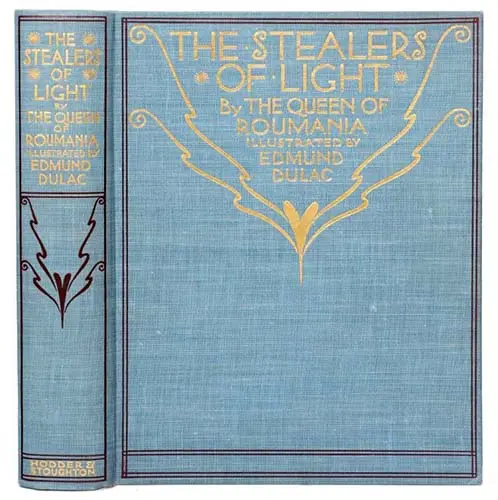
Among the lesser-known treasures of Edmund Dulac’s illustrious career, the 1916 edition of The Stealers of Light occupies a unique and fascinating place. Published by Hodder & Stoughton in London during the darkest days of World War I, this slender volume represents a remarkable collaboration between one of the Golden Age’s greatest illustrators and a most unexpected author: Marie, Queen of Romania .
Born into the British royal family as Princess Marie of Edinburgh, granddaughter of Queen Victoria, Marie (1875–1938) had married Crown Prince Ferdinand of Romania in 1892 . By 1916, the year this book appeared, Romania had joined Britain, France, and Russia in the war against Germany, and Marie herself volunteered as a nurse in military hospitals . Yet amid the turmoil of war, she found time to write—and in The Stealers of Light, she crafted an allegorical fairy tale of remarkable ambition.
The story centers on Luath Malvorno, an alchemist whose ambitions are both grand and terrifying. “To work for others may give joy to some,” he declares; “but my longing is to ride on the world, as I would ride a turbulent horse, breaking its will beneath the strength of my grip”. His obsession is the pursuit of the Water of Life, eternal youth—and he cares nothing for the innocent young woman, Ilona, who loves him. She returns again and again to her tormentor, pursuing an “unavowable passion” that corrupts her innocence and turns her, ultimately, into a stealer of light herself .
It is a dark fable, more psychological than whimsical—a meditation on corruption, manipulation, and the ways that innocence, when betrayed, can become complicit in its own destruction. Dulac’s illustrations, though few in number, capture this moral complexity with characteristic brilliance. The book contains two tipped-in color plates, a frontispiece and one additional illustration, making it one of Dulac’s more limited efforts in terms of quantity—yet each image is a jewel.
Critics have noted that Dulac’s work for The Stealers of Light showcases his mature phase, where his earlier Orientalist flourishes merged with a more symbolic, almost modernist approach . The illustrations are rich in jewel tones and intricate Eastern European folk motifs, reflecting both Art Nouveau elegance and the romantic nationalism of Marie’s adopted homeland . Despite wartime paper shortages, the edition was produced with exceptional care—a testament to the value placed on Dulac’s art even in difficult times .
The physical book itself was a handsome production: original blue cloth with gilt stamping, measuring approximately 20 by 15 centimeters . The limited number of color plates makes it a rarity among Dulac’s oeuvre—less ostentatious than his Arabian Nights or Rubáiyát, but no less beautiful. Today, first editions are scarce and highly prized by collectors, with copies commanding prices in the hundreds of dollars .
The Stealers of Light may not be the most famous volume in Dulac’s bibliography, but it may be one of the most intriguing. It represents a convergence of royal authorship, wartime publishing, and artistic genius—a book born of a moment when fairy tales offered not escape from reality, but a means of grappling with its darkest currents. In Dulac’s luminous illustrations, the story of innocence corrupted and light stolen finds a visual language of haunting beauty, a reminder that even in the shadows, art endures.
Recommended for Collectors
- The Dreamer of Dreams (1915) by Queen Marie, also illustrated by Dulac – A companion volume of royal fairy tales
- The Kingdom of the Pearl (1920) by Marguerite d’Aincourt, illustrated by Dulac – For another Dulac-illustrated Eastern European fantasy
- The Firebird and Other Russian Fairy Tales (1978) illustrated by Boris Zvorykin – A complementary Slavic-inspired visual feast
Other books illustrated by Edmund Dulac available in our gallery: Stories from the Arabian Nights, Lyrics, Pathetic and Humourous from A to Z, The Rubaiyat of Omar Khayyam, The Sleeping Beauty, Stories from Hans Andersen, The Bells, and other poems, Princess Badoura, Sindbad the Sailor and other stories, The Kingdom of the Pearl.
Complete list of books illustrated by Edmund Dulac.
Art Gallery: Edmund Dulac – Stealers of Light 1916