A Pocket-Sized Treasure: Jennie Harbour’s Fairytale Gems
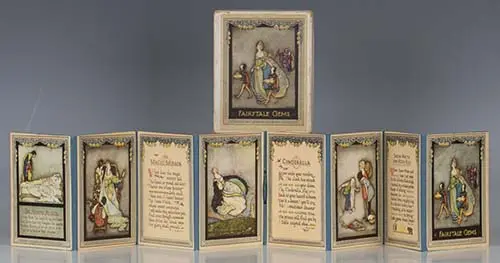
There is something utterly delightful about a book that fits in the palm of a child’s hand—a treasure meant to be held close, pored over, and cherished. Jennie Harbour’s Fairytale Gems, published by Raphael Tuck & Sons around 1920, is precisely such a volume. This charming little book, with its concertina format and exquisite illustrations, represents a perfect encapsulation of the Art Deco sensibility meeting the timeless appeal of classic fairy tales.
Jennie Harbour (1893–1959) was an English artist whose career flourished in the 1920s and 1930s. By 1919, she was working for Raphael Tuck & Sons, a London publisher renowned for producing postcards, calendars, and beautifully illustrated books . Her work quickly gained international popularity, with critics praising her “delightfully distinctive, bright and pleasant” style. Harbour’s illustrations embodied the Art Deco movement’s characteristic soft, sinuous lines and elegant flourishes, yet she brought to them a warmth and whimsy that made her work particularly beloved in nurseries and libraries alike .
Fairytale Gems is a rare and unusual publication. Unlike a traditional bound book, it takes the form of a panorama or concertina—a fold-out structure that extends to reveal eight illustrated panels, each accompanied by verses written by Hilda Hart . When folded, the book measures a mere 9 by 12 centimeters (approximately 3.5 by 4.5 inches), making it a true pocket treasure. When fully extended, however, it stretches to an impressive 75 centimeters, transforming into a miniature gallery of fairy-tale enchantment . The panels are printed on thick card, hinged with cloth and originally secured with a blue ribbon tie, and the volume was issued in its own illustrated gift box.
The eight tales Harbour brings to life in this small volume are a carefully chosen selection of classic fairy stories: The Goose Girl, Red Riding Hood, The Beautiful Princess, Beauty and the Beast, The Sleeping Beauty, The Magic Mirror, Cinderella, and Snow-White and Rose-Red. Each panel presents a full-color illustration accompanied by verses that distill the essence of each tale into a few charming lines. The colophon notes that the book was “Designed in England; Printed in Bavaria,” reflecting the international scope of fine book production in the period.
What makes Harbour’s illustrations in Fairytale Gems so distinctive is their graceful fusion of Art Deco elegance with a tender, romantic sensibility. Her figures are rendered with soft, curving lines, and she often employed a technique of setting her luminous subjects against darker backgrounds, creating a striking sense of depth and emphasis . The color palette is delicate yet vibrant—soft pinks, gentle blues, and warm golds that evoke the dreamlike quality of the stories she illustrates. Her characters possess an almost porcelain delicacy, their expressions serene, their costumes flowing with a refined, theatrical grace.
Fairytale Gems occupies a special place within Harbour’s body of work. It appeared at the beginning of her most productive period, just before she went on to illustrate larger volumes such as My Favourite Book of Fairy Tales (1921) and My Book of Mother Goose Nursery Rhymes . In later years, she would contribute illustrations to Andrew Lang’s celebrated fairy books, including The Yellow Fairy Book (1927) and The Green Fairy Book (1934) . Yet Fairytale Gems remains something of a hidden treasure—a delicate, intimate work that captures the essence of her style in miniature.
Today, surviving copies of Fairytale Gems are highly prized by collectors. The book’s delicate concertina format made it vulnerable to wear, and examples in good condition, especially with the original gift box and ribbon ties intact, are scarce and sought after . For those fortunate enough to encounter it, the book offers a glimpse into a particular moment in publishing history—when fairy tales were presented as treasures, and artists like Jennie Harbour devoted their considerable talents to creating objects of lasting beauty.
In its small format and its careful craftsmanship, Fairytale Gems embodies the philosophy of the Golden Age of Illustration: that books for children deserved the same artistry, attention, and reverence as books for adults. Jennie Harbour’s delicate, dreamlike illustrations continue to enchant, reminding us that true gems often come in the smallest packages.
For fans of Fairytale Gems, you might also enjoy:
- Arthur Rackham’s Book of Pictures (1913) – Known for his intricate, whimsical, and occasionally eerie style, Rackham’s work shares a similar magical quality.
- Edmund Dulac’s Stories from Hans Andersen (1911) – Dulac’s luminous, painterly illustrations offer another stunning take on classic fairy tales.
- Kay Nielsen’s East of the Sun and West of the Moon (1914) – Nielsen’s bold, Art Deco-inspired illustrations provide a more stylized but equally enchanting fairy tale experience.
- My Book of Favourite Fairy Tales (1921) also illustrated by Harbour – her other major anthology
- The Fairy Tales of the Brothers Grimm (1925) illustrated by Anne Anderson – contemporary style
Art Gallery: Jennie Harbour – Fairytale Gems 1920
![Jennie Harbour - Fairytale Gems [harbour-fairy01] (art, illustrations)](https://www.nocloo.com/wp-content/plugins/justified-image-grid/timthumb.php?src=https%3A%2F%2Fwww.nocloo.com%2Fart%2Fharbour-fairy%2Fharbour-fairy01.jpg&h=280&q=90&f=.jpg "Jennie Harbour - Illustrations from Fairytale Gems 1920")
![Jennie Harbour - Fairytale Gems [harbour-fairy02] (art, illustrations)](https://www.nocloo.com/wp-content/plugins/justified-image-grid/timthumb.php?src=https%3A%2F%2Fwww.nocloo.com%2Fart%2Fharbour-fairy%2Fharbour-fairy02.jpg&h=280&q=90&f=.jpg "Jennie Harbour - Illustrations from Fairytale Gems 1920")
![Jennie Harbour - Fairytale Gems [harbour-fairy03] (art, illustrations)](https://www.nocloo.com/wp-content/plugins/justified-image-grid/timthumb.php?src=https%3A%2F%2Fwww.nocloo.com%2Fart%2Fharbour-fairy%2Fharbour-fairy03.jpg&h=280&q=90&f=.jpg "Jennie Harbour - Illustrations from Fairytale Gems 1920")
![Jennie Harbour - Fairytale Gems [harbour-fairy04] (art, illustrations)](https://www.nocloo.com/wp-content/plugins/justified-image-grid/timthumb.php?src=https%3A%2F%2Fwww.nocloo.com%2Fart%2Fharbour-fairy%2Fharbour-fairy04.jpg&h=280&q=90&f=.jpg "Jennie Harbour - Illustrations from Fairytale Gems 1920")
![Jennie Harbour - Fairytale Gems [harbour-fairy05] (art, illustrations)](https://www.nocloo.com/wp-content/plugins/justified-image-grid/timthumb.php?src=https%3A%2F%2Fwww.nocloo.com%2Fart%2Fharbour-fairy%2Fharbour-fairy05.jpg&h=280&q=90&f=.jpg "Jennie Harbour - Illustrations from Fairytale Gems 1920")
![Jennie Harbour - Fairytale Gems [harbour-fairy06] (art, illustrations)](https://www.nocloo.com/wp-content/plugins/justified-image-grid/timthumb.php?src=https%3A%2F%2Fwww.nocloo.com%2Fart%2Fharbour-fairy%2Fharbour-fairy06.jpg&h=280&q=90&f=.jpg "Jennie Harbour - Illustrations from Fairytale Gems 1920")
![Jennie Harbour - Fairytale Gems [harbour-fairy07] (art, illustrations)](https://www.nocloo.com/wp-content/plugins/justified-image-grid/timthumb.php?src=https%3A%2F%2Fwww.nocloo.com%2Fart%2Fharbour-fairy%2Fharbour-fairy07.jpg&h=280&q=90&f=.jpg "Jennie Harbour - Illustrations from Fairytale Gems 1920")
![Jennie Harbour - Fairytale Gems [harbour-fairy08] (art, illustrations)](https://www.nocloo.com/wp-content/plugins/justified-image-grid/timthumb.php?src=https%3A%2F%2Fwww.nocloo.com%2Fart%2Fharbour-fairy%2Fharbour-fairy08.jpg&h=280&q=90&f=.jpg "Jennie Harbour - Illustrations from Fairytale Gems 1920")
![Jennie Harbour - Fairytale Gems [harbour-fairy09] (art, illustrations)](https://www.nocloo.com/wp-content/plugins/justified-image-grid/timthumb.php?src=https%3A%2F%2Fwww.nocloo.com%2Fart%2Fharbour-fairy%2Fharbour-fairy09.jpg&h=280&q=90&f=.jpg "Jennie Harbour - Illustrations from Fairytale Gems 1920")