W. Heath Robinson – Illustrations for Midsummer Night’s Dream 1914
A Comic Vision: William Heath Robinson’s A Midsummer Night’s Dream
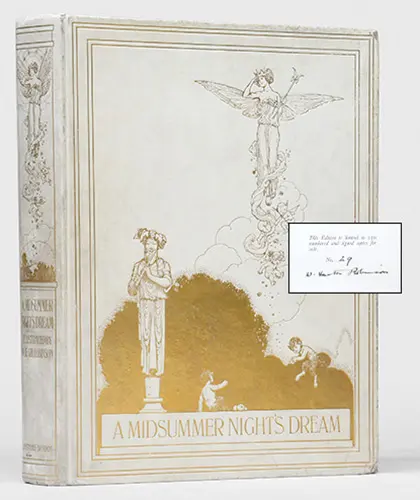
A Midsummer Night’s Dream (1914) Limited Edition
There are certain works of literature that seem to invite a particular kind of interpretation—a reverence, a solemnity, an approach that emphasizes their beauty and their profundity. William Heath Robinson took a different path. His 1914 edition of Shakespeare’s A Midsummer Night’s Dream is a work of wit, whimsy, and irreverent charm—a reminder that the play, at its heart, is a comedy, and that comedy, when rendered with genius, can be a form of art as enduring as any other.
William Heath Robinson (1872–1944) was a British illustrator whose name would eventually become synonymous with a particular kind of whimsical, over-engineered contraption—the “Heath Robinson” device. Yet before that fame, he was a member of one of the most remarkable artistic families of the era, the brothers Robinson: Charles, Thomas, and William. Each made his mark in illustration, but William brought to his work a distinctive sense of humor, a playful spirit, and an eye for the absurd that set him apart from his contemporaries.
The 1914 edition of A Midsummer Night’s Dream was published by Constable & Company in London. It was a handsome production, containing twelve full-page color plates and numerous black-and-white illustrations woven throughout the text. The binding was in cloth with gilt stamping, and the book was issued in both trade and limited editions. It appeared at a moment when Shakespeare illustration was dominated by the ethereal visions of Arthur Rackham and the decorative elegance of Edmund Dulac—and Robinson offered something altogether different.
What distinguishes Robinson’s approach is his embrace of the play’s comedy. His fairies are not the gossamer-winged, ethereal creatures of the Pre-Raphaelite tradition. They are smaller, earthier, more mischievous—more like the sprites of English folklore than the idealized beings of Victorian art. Puck, in Robinson’s hands, is a true hobgoblin, his face a mask of delighted mischief, his body contorted into poses of manic energy. Oberon and Titania possess a regal dignity, but it is a dignity undercut by the absurdity of their quarrel over a changeling boy.
The mechanicals—Bottom, Quince, Flute, and the rest—receive particularly inspired treatment. Robinson’s Bottom is a masterpiece of comic characterization: a plump, self-important weaver with an ass’s head that seems almost an extension of his personality. The rehearsal scene in the wood is rendered with the timing of a silent comedy, each figure frozen in a moment of theatrical calamity. These are not merely illustrations; they are performances, captured on the page.
Robinson’s color palette in this work is rich and varied—deep greens for the forest, warm browns for the rustic scenes, touches of gold and rose for the fairy court. Yet his black-and-white illustrations are equally remarkable. His line work is fluid and expressive, capturing movement and expression with an economy of means. The decorative elements—initials, tailpieces, marginal drawings—are infused with the same playful spirit that animates the larger illustrations.
The critical reception of Robinson’s Dream was warm, though it did not achieve the same level of commercial success as Rackham’s 1908 edition. Yet over time, its reputation has grown. Collectors and admirers of Robinson’s work recognize it as a high point in his career—a volume where his comic sensibility found perfect alignment with a text that rewards humor as much as beauty.
Today, the 1914 edition is a prized collectible. First editions in good condition, with clean plates and intact bindings, are increasingly scarce. For those fortunate enough to own a copy, the book offers a fresh perspective on a familiar masterpiece—a reminder that Shakespeare’s Dream is, above all, a play, and that a play, to live fully, must be performed. Robinson’s illustrations are performances: spirited, comic, and utterly alive.
In the pages of this book, the wood near Athens becomes a stage. Puck grins, Bottom brays, the lovers quarrel, and the fairies dance. And William Heath Robinson, with his brush and his pen, invites us to laugh with them—to see, in the chaos of the forest, the joy that has made A Midsummer Night’s Dream endure for four centuries. It is a vision of Shakespeare that reminds us that the greatest art, like the greatest comedy, is the art of making us smile.
To provide the best experiences, we use technologies like cookies to store and/or access device information. Consenting to these technologies will allow us to process data such as browsing behavior or unique IDs on this site. Not consenting or withdrawing consent, may adversely affect certain features and functions.
Functional
Always active
The technical storage or access is strictly necessary for the legitimate purpose of enabling the use of a specific service explicitly requested by the subscriber or user, or for the sole purpose of carrying out the transmission of a communication over an electronic communications network.
Preferences
The technical storage or access is necessary for the legitimate purpose of storing preferences that are not requested by the subscriber or user.
Statistics
The technical storage or access that is used exclusively for statistical purposes.The technical storage or access that is used exclusively for anonymous statistical purposes. Without a subpoena, voluntary compliance on the part of your Internet Service Provider, or additional records from a third party, information stored or retrieved for this purpose alone cannot usually be used to identify you.
Marketing
The technical storage or access is required to create user profiles to send advertising, or to track the user on a website or across several websites for similar marketing purposes.